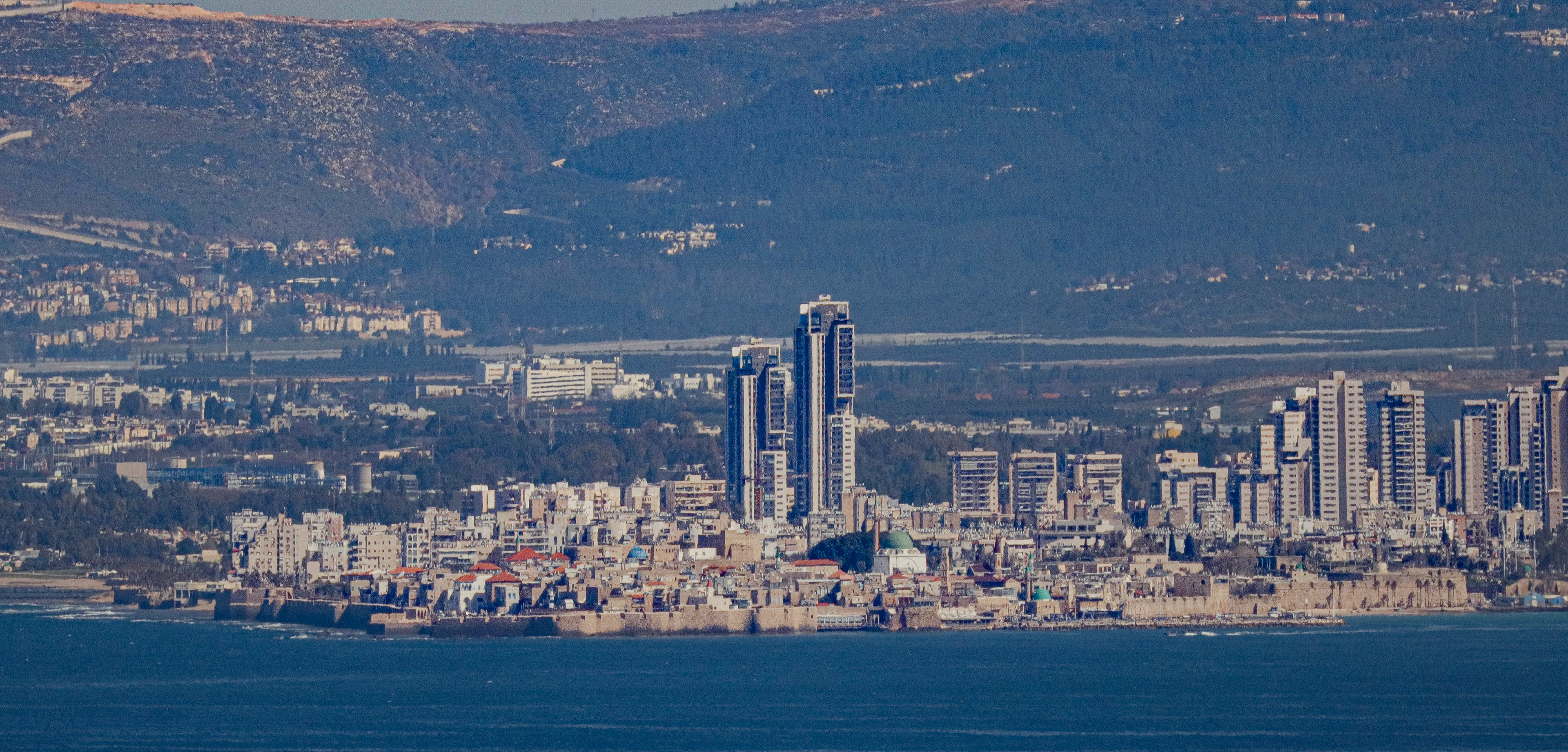
From across the water, the old city of Acre appears almost like a stone ship anchored at the edge of the Mediterranean. The ancient walls form a continuous line along the shoreline, thick and weathered, their sandy limestone color glowing softly in the afternoon light. These fortifications, built and rebuilt through centuries of Crusaders, Ottomans, and earlier civilizations, still give the city the unmistakable silhouette of a medieval stronghold. Even at a distance you can sense the density of history packed behind those walls—narrow alleys, caravanserais, mosques, markets, and courtyards layered on top of each other across more than a thousand years.
Inside the walls, the rooftops create a patchwork of red tiles, pale stone terraces, and small domes. Rising above them is the unmistakable green dome of the Al-Jazzar Mosque, one of the most prominent Ottoman landmarks in the region. The dome sits slightly inland from the seafront, but from this angle it becomes a visual anchor for the whole historic district, hinting at the spiritual and civic life that has centered around the mosque since the late eighteenth century. Around it, smaller minarets, old khans, and residential blocks blend into a tightly packed urban texture that feels almost unchanged since the days when Acre was a key Mediterranean port.
What makes the view striking, though, is the contrast behind the walls. Beyond the compact medieval city rises a completely different landscape: clusters of modern apartment towers, glass and concrete high-rises, and sprawling neighborhoods stretching inland across the coastal plain. These buildings belong to the contemporary city surrounding the historic core, their vertical lines emphasizing just how low and dense the old city remains. The juxtaposition is dramatic—centuries-old fortifications in the foreground, twenty-first-century urban growth standing directly behind them.
Further back still, the landscape opens toward the wider geography of northern Israel. Hills rise in the distance, softly blue from atmospheric haze, forming the edge of the Galilee region. Industrial zones, highways, and scattered residential areas appear faintly between the hills and the coastline, reminders that this ancient port now sits inside a much larger modern economic corridor stretching along the Mediterranean.
Seen from afar like this, Acre reveals itself as a layered city rather than a single place. The walls speak of Crusader battles and Ottoman governors, the mosque reflects centuries of Islamic architectural heritage, and the towers behind them signal the pressures and ambitions of a modern coastal metropolis. The entire scene compresses history into one frame—an old Mediterranean fortress holding its ground while the contemporary city steadily rises around it.