Some restaurants tell you they are seasonal. Claro shows you, and it does it in a single dish before the mains ever arrive. Ran Shmueli's first restaurant sits inside a 150-year-old Templar building in Sarona — thick stone walls, high ceilings, and one of the largest open kitchens in the country burning away in the middle of the room. The setting alone would carry most places. Claro is not most places, because the building is the least interesting thing on the table.
The farm-to-table label gets attached to almost everything now, which usually means a herb garden out back and a paragraph on the menu. Here it is closer to logistics than marketing. A Claro van runs out to fields and greenhouses most mornings, and what it brings back is on plates within hours. The menu changes daily as a result, and every few weeks a single fruit or vegetable is pulled to the center and worked from every angle. You are not eating a fixed concept. You are eating whatever the country happened to be growing that week, handled by a chef with 25 years of judgment about when to stop.
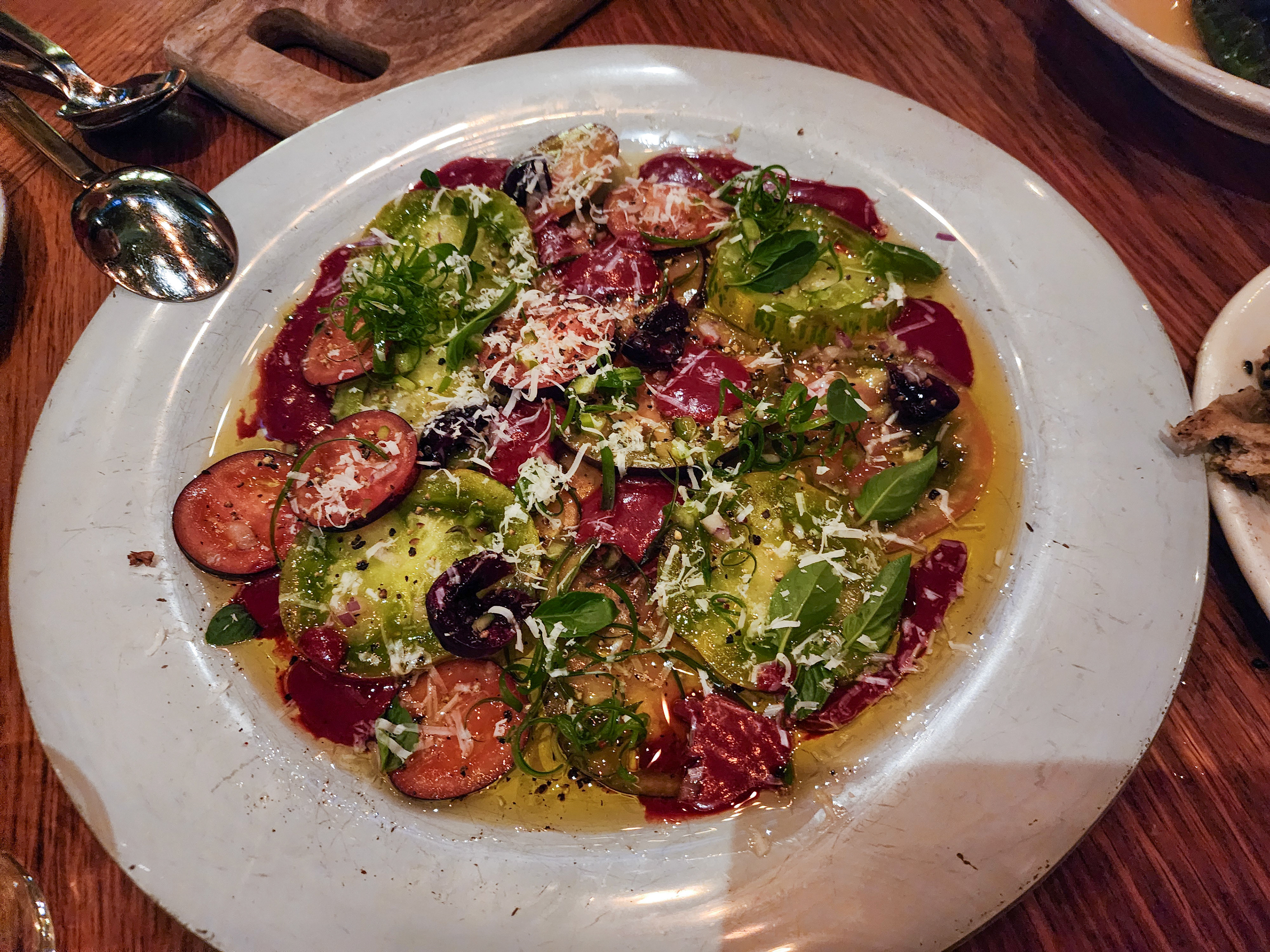
The tomato carpaccio is the clearest argument for all of it. Thin slices of heirloom tomatoes fan across the plate in colors you do not get from a supermarket — deep red, an almost-black purple, and an unripe-looking green variety that turns out to be the sweetest thing on the plate. They are dressed with good olive oil, cracked black pepper, a scatter of halved olives, spring onion sliced fine, and torn basil and oregano still smelling of the garden. Over the top goes a snowfall of grated hard cheese, salty and dry against the fruit. That is the entire dish. There is nowhere to hide.
And that is the point. A tomato carpaccio is honest to the edge of reckless. If the tomatoes are ordinary, you know immediately, because nothing has been cooked or sauced or emulsified to cover for them. Claro can serve this because it can guarantee the tomatoes, and it can only guarantee them for the stretch of the year when they actually taste like this. Order it in February and it would be a different, lesser plate, if it appeared at all. The kitchen's restraint here is the flex: no technique, no cleverness, just produce that earns the minimalism. Shmueli's "Med Kitchen" travels — Spain, Italy, Greece, Lebanon, Turkey — but this dish stays home and lets Israeli soil do the talking.
The rest of the meal keeps the promise. The pasta and breads are made in house, the tabun turns out fish and meat with the same light touch, and the service is warm without being formal — the reliable Tel Aviv register of feeling special and completely relaxed at once. It is not cheap, and it does not pretend to be. It is also consistently full, which in a city that discards restaurants at speed is the highest compliment available.
Book ahead, especially for a weekend dinner, and if the tomato carpaccio is on the menu the day you go, start there. It is the whole restaurant on one plate.