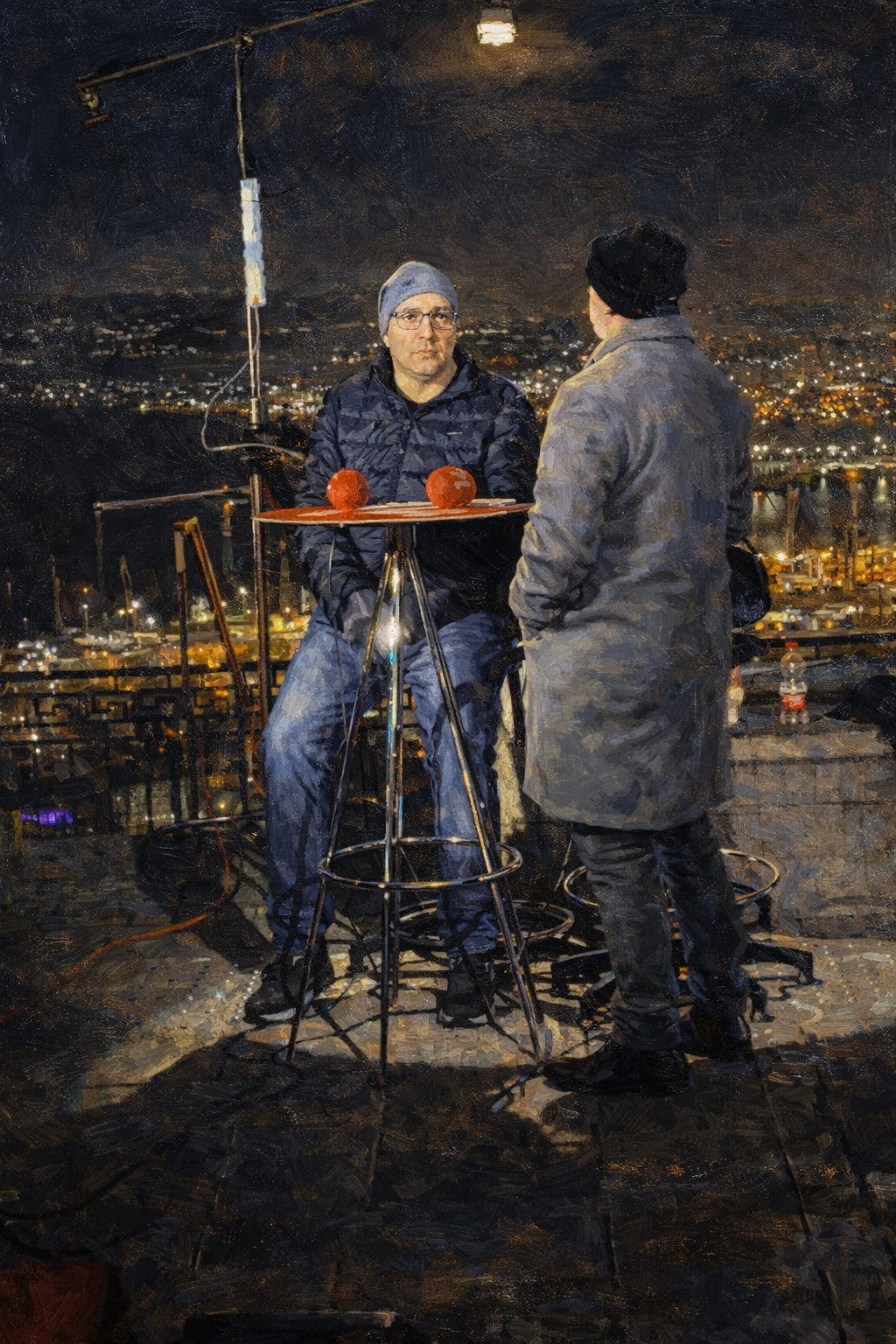
The image unfolds like a live broadcast caught in the middle of history, not staged but happening, right now. Two figures occupy a small rooftop platform above Haifa, the harbor stretching behind them in scattered gold lights, interrupted by darkness that feels heavier than usual. It’s the kind of night where the city doesn’t sleep—it waits. The seated reporter faces forward, tense but composed, while the other man stands close, half-turned, as if reacting to something just heard through an earpiece or carried by the wind from below.
This reads unmistakably as a live segment from Channel 14, the kind of field reporting that happens when studios are too far from the story. The red microphones on the table glow under harsh artificial light, almost symbolic—small but loud, fragile but present. Around them, cables snake across the stone ground, a reminder that even in a war zone, the signal must hold.
Behind them, the port and industrial lines of Haifa flicker under pressure. The stillness is deceptive. The wider context presses in from every direction: missile alerts, intercepted trajectories, impacts not far from here. Iranian strikes have repeatedly targeted northern Israel, including Haifa’s infrastructure, turning the skyline into both a landmark and a potential target. The harbor lights, in that sense, feel less like beauty and more like exposure.
The lighting in the scene isolates the journalists almost theatrically, but nothing about it feels staged. One overhead lamp cuts through the darkness, casting sharp shadows and defining the urgency of the moment. The men are bundled against the cold, but also against something else—uncertainty, maybe. You can almost imagine the pauses between sentences, the off-camera producer counting down, the distant echo of sirens that may or may not return.
What makes the image linger is that it sits right at the intersection of routine and crisis. A table, two chairs, a conversation—that’s the routine. A city under threat, a war unfolding in real time—that’s the rupture. The poster captures both at once, and doesn’t try to resolve the tension.
It feels like a broadcast you don’t turn off. Not because of what’s being said, necessarily, but because of where it’s being said from.